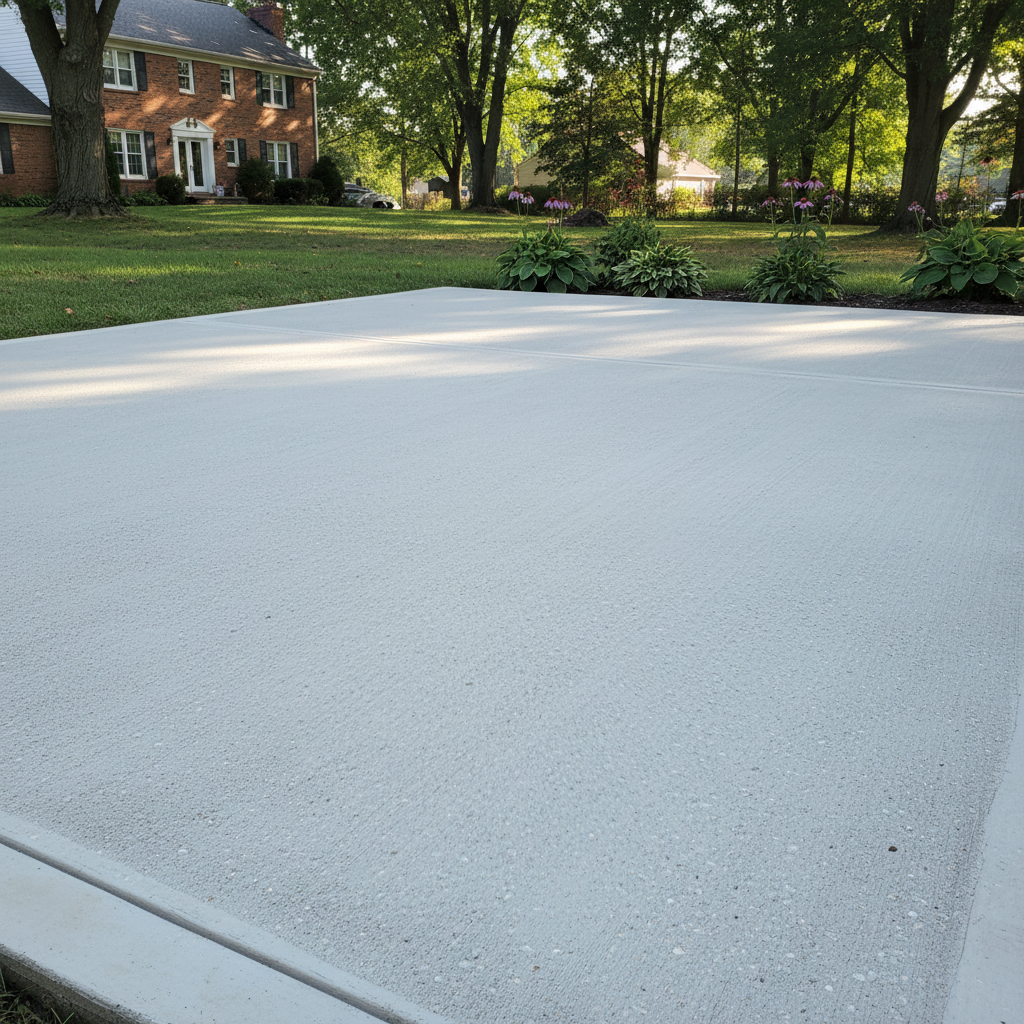
So, you're thinking about pouring some concrete around your place, huh? Maybe a small pad for the trash cans, or a new step. It's a common thought for homeowners, I get it. You see a bag of mix at the hardware store, and it doesn't look too tough. But let me tell you, there's a big difference between mixing a little patch and pouring a slab that's actually going to last. As someone who's been doing this for years here in Muncie, I've seen it all – the good, the bad, and the really ugly DIY attempts.
Before You Even Think About Mixing
First things first, you gotta plan. What are you pouring? A small walkway, a patio, a shed foundation? The size and purpose dictate a lot. If it's anything bigger than, say, a 3x3 foot pad, you're probably getting into pro territory pretty fast. For anything structural, like a foundation or a driveway that's going to hold a car, don't even think about doing it yourself. That's a job for folks with the right equipment and experience, plain and simple.
You need to think about drainage, too. We get some serious rain here in Muncie, especially in the spring. You don't want water pooling on your new concrete or, worse, running back towards your house. Slope is critical. A general rule of thumb is at least a quarter-inch drop per foot away from any structure. If you don't get that right, you're looking at headaches down the road.
Then there's the excavation. You've got to dig out the area properly. For most residential slabs, you'll want at least 4 inches of concrete, plus a good base of compacted gravel underneath – usually 4 to 6 inches. That means digging down 8 to 10 inches total. And you need to check for utilities! Call 811 before you dig, every single time. You really don't want to hit a gas line or a water main, trust me on that one.
The Pouring Process: Where DIY Gets Tricky
Alright, let's say you've got your forms built, your base is down and compacted, and you're ready to pour. For a small project, you might be able to mix bags yourself. But think about it: a standard 80-pound bag of concrete mix covers about 0.6 cubic feet. A 4x4 foot pad, 4 inches thick, is about 5.3 cubic feet. That's almost 9 bags! And you need to mix them consistently and quickly. Concrete doesn't wait around, you know?
For anything larger, you're talking about ordering ready-mix concrete. That's where things get really serious. A concrete truck shows up, and you've got a limited window to get that concrete placed, leveled, and finished. It's not like you can take a coffee break. You need a crew, and you need to know what you're doing. Spreading, screeding (leveling), floating, and then finishing – each step has to happen at the right time. If you miss that window, the concrete starts to set, and you're left with a lumpy, uneven mess.
I've seen homeowners try to pour a small patio themselves. They get the concrete down, but then they don't know how to finish it. They end up with a rough surface that's hard to clean and doesn't look good. Or they overwork it, bringing too much water to the surface, which weakens the top layer and leads to dusting and scaling later on.
After the Pour: Curing and Care
Once the concrete is down and finished, your job isn't over. Curing is probably the most overlooked part of DIY concrete. It's not just about letting it dry; it's about letting it harden properly. Concrete gains strength through a chemical reaction with water, not just by drying out. You need to keep it moist for at least 3-7 days, sometimes longer depending on the mix and the weather. That means covering it with plastic, or even better, keeping it wet by misting it or using a curing compound.
If you don't cure it right, your concrete will be weaker, more prone to cracking, and won't last as long. This is especially true with our freeze-thaw cycles here in Central Indiana. Poorly cured concrete will spall and chip much faster when winter rolls around.
When to Call a Pro (Like Midway Concrete Co)
Here's the honest truth: if your project is anything more than a small, non-structural patch or a very small, simple pad, you should call a professional. Seriously. For driveways, large patios, garage floors, foundations, or anything that needs to look good and last for decades, you need the right tools, the right crew, and the right experience.
A professional concrete contractor, like us at Midway Concrete Co, knows the local soil conditions – like the clay we often deal with around the Ball State area – and how to prepare the subgrade properly. We know how to set forms accurately, calculate the right amount of concrete, and get it delivered and placed efficiently. We have the power screeds, bull floats, power trowels, and all the other specialized equipment that makes a huge difference in the final product. Plus, we understand expansion joints, control joints, and proper drainage, which are all critical for longevity.
Trying to save a few bucks by DIYing a major concrete project often ends up costing more in the long run when you have to tear it out and do it again. Don't learn that lesson the hard way. For those bigger jobs, give us a call. We're happy to talk through your project and give you an honest assessment of what it takes.